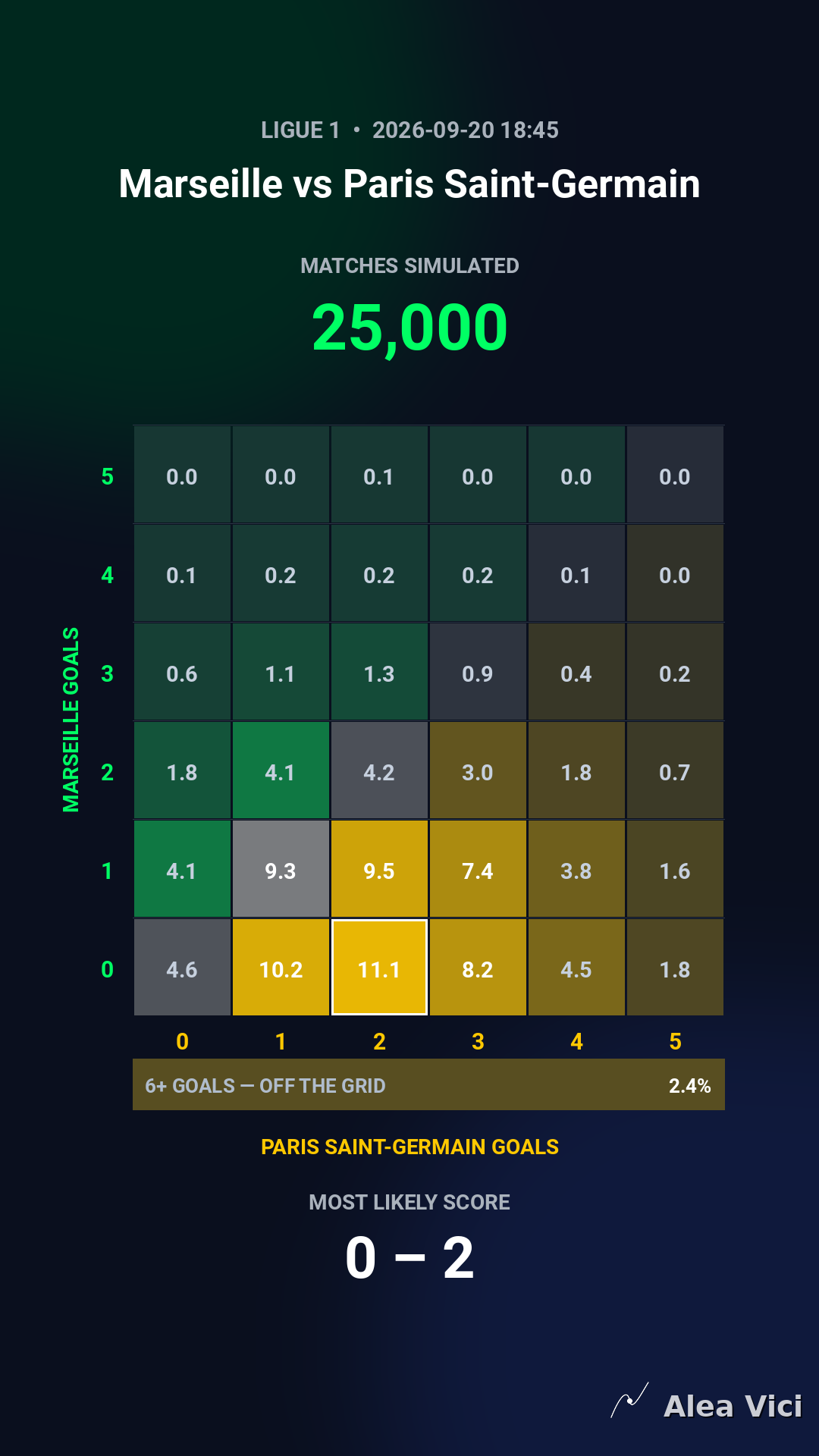
Marseille vs Paris Saint-Germain
Our model puts a Paris Saint-Germain win at 66.4% in this Ligue 1 fixture — the clearest call on this fixture. Expected goals run 0.87 to 2.18.
What this probability has been worth
A number is worth what it has been worth. Across 1,354 predictions published before kick-off and scored against the result afterwards, the calls we priced between 65% and 75% came in 72.6% of the time — 117 fixtures in that band. The model claimed 69.3%, so the two are within 3.4 points of each other. In this range the stated probability has meant roughly what it says.
The ratings gap
Paris Saint Germain carry a rating of 1941 against 1680 for Marseille, a gap of 261 points. On our scale that is the difference between a side that controls most of its fixtures and one that has to earn each of them. It is also the single largest input into the probabilities above.
Attack against defence
The single rating hides where the mismatch actually sits. Splitting it, Paris Saint-Germain's attack should find room against Marseille's defence, by 336 points. That is the mechanism behind the expected-goals line rather than a separate opinion about it.
Marseille are off their season peak
Marseille peaked at 1758 this season and sit at 1680 today, 78 points below their own best. Measuring a side against itself rather than against the table is often the earlier signal, and it is not visible in a league position.
How often they shoot
Paris Saint-Germain take 17.5 shots a match against an average of 11.8. Volume like that usually means territory rather than precision, and it is why a side can dominate a match and still not win it.
Early or late
76.5% of Marseille's goals have come after the break, against 57.1% for the sides we measure, over 17 goals. A side that scores this late is usually one that grows into matches or finishes them stronger than it starts — and one whose half-time score says less than usual about the result.
Behind the defence
76.1% of the shots on target Paris Saint-Germain face do not end up in the net, against 67.7% for the sides we measure. That is a keeper and a defence having a good run of it — and a figure that tends to drift back toward the middle, which is worth remembering before reading too much into it.